
ART FOR OCEAN CONSERVATION
JONAT DEELSTRA X REEFOLUTION
ADOPT AN ARTISTIC TRIBUTE TO THE SEA! HOW IT WORKS
By following this link, you’re invited to select and support one of Jonat Deelstra’s three sculptures. This act of support allows you to dedicate the sculpture in homage to someone special, personalizing this artistic contribution to the sea. Upon its placement, the sculpture shall soon be overgrown by corals and integrated into the marine ecosystem. You’ll be rewarded with photographs documenting your sculpture’s journey and its final resting place amongst the corals.
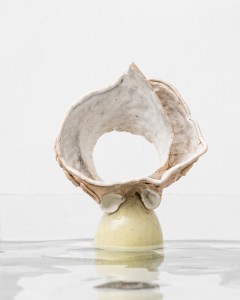
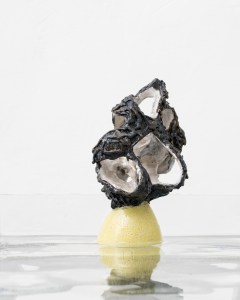

The three sculptures made by Jonat Deelstra
THE ARTISTIC WORK OF JONAT DEELSTRA
Jonat Deelstra, an Amsterdam-based artist renowned for his project “Funeral home: The North Sea” seeks to support the restoration of coral reefs through his artwork. These sculptures, developed in collaboration with the European Ceramic Workcentre, University Wageningen, and Hortus Botanicus Amsterdam, serve as a symbol of the beauty and need to conserve the ocean.
A SCULPTURE AS AN ART MONUMENT
In a touching tribute last year, one of Jonat’s sculptures was symbolically dedicated to his grandfather and placed within our Kenyan reef project. It has since become a beacon for new coral growth and a sanctuary for fish. Discover the full story here.

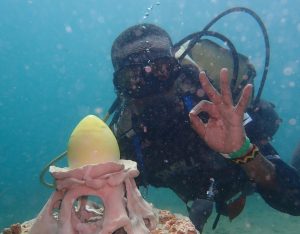
Reef Ranger Dzivula installing Jonat’s ceramic monument at REEFolution
Fundraising campaign for REEFolution
This year, Jonat Deelstra offers three of his ceramic sculptures, with a generous portion of the proceeds directly supporting the REEFolution initiative. These sculptures will find a new home nestled among artificial reefs, where they will contribute to the ecosystem’s vitality.
YOUR SUPPORT MAKES A DIFFERENCE
The funds raised will be instrumental in coral reef restoration in shall be used to train new REEF rangers and restore and protect coral reefs in Kenya. If you’re moved by the fusion of art and environmental conservation, this might resonate with you. Jonat Deelstra’s sculptures are available for a limited time.
Dive into this unique opportunity to make a difference here: https://www.jonatdeelstra.com/reefolution-cross-over
* Unlike his “Funeral Home: the North Sea” project, the sculptures stand purely as artistic monuments. This initiative strips away all religious connotations, focusing solely on their environmental impact and artistic value.
You might also like…


How we take action
The reefolution
blueprint

reef rangers
REEFolution offers a 3-month REEF Ranger program which is aimed to provide practical diving and coral restoration skills to local community members.
Read morereef rangers
coral restoration
Our REEF Rangers actively restore coral reefs using a variety of different science-based methods.
Read morecoral restoration
education
Our REEF Rangers visit local primary and secondary schools to provide marine animal ecology classes aimed to increase local awareness.
Read moreeducation
science
Our REEF Rangers collaborate with international scientists aimed to investigate new coral restoration methods
Read morescience
Kite for Kenya is an all-female project on a mission to raise awareness and funds for ocean conservation along the East African coastline.
In January 2023, these girls were the first to kite surf the Kenyan Coast. They raised $8000,- for REEFolution, which was a great donation that kept our coral restoration project up and running. We were so grateful for their support and willingness to raise awareness for the importance of coral restoration.
And guess what? This year they’re doing it again!!
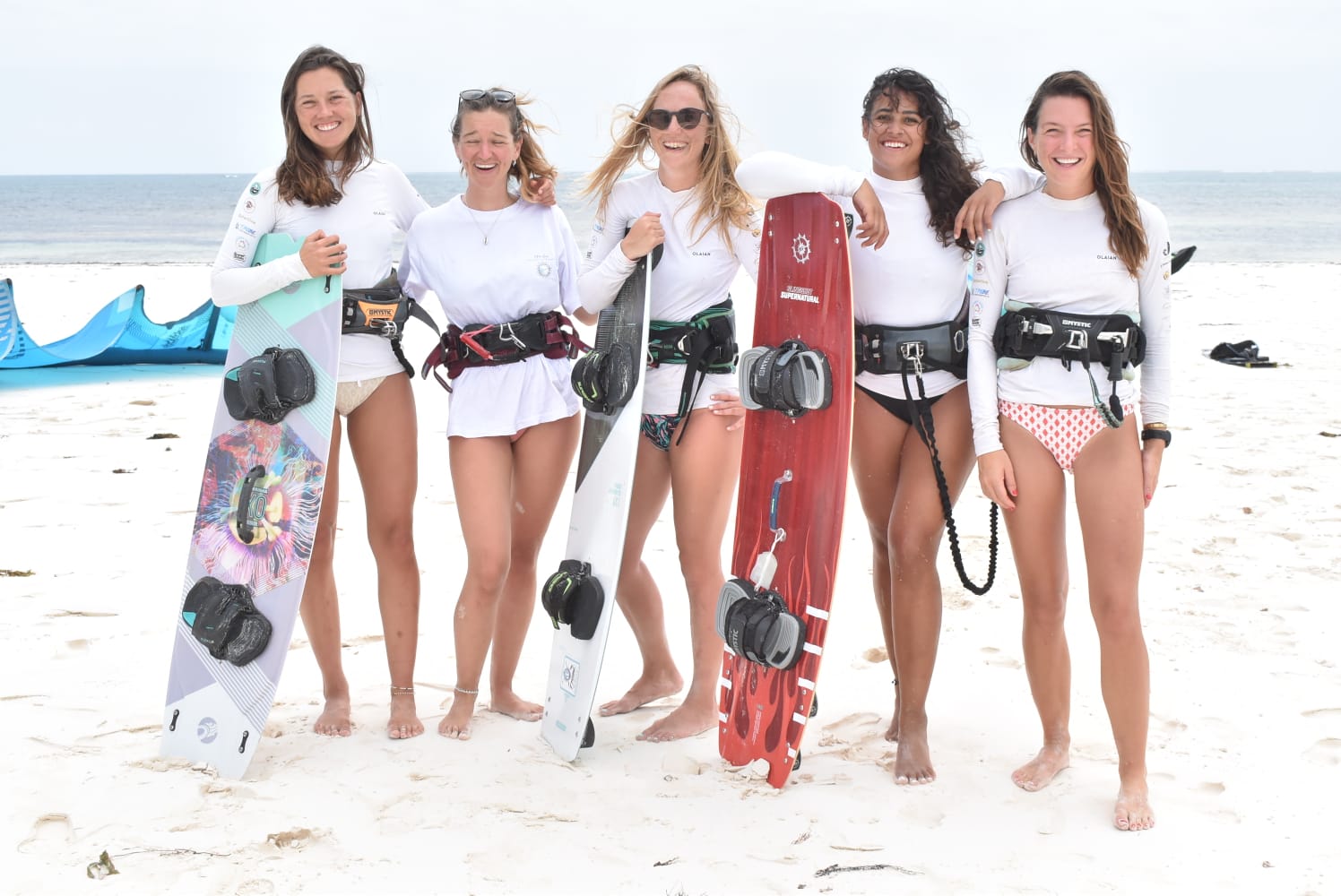

Following this inspiring pilot in 2023, Kite for Kenya has teamed up with REEFolution and DuotoneKiteboarding to bring global awareness to one of the world’s most important marine ecosystems!
On the 13th of January 2024, the all-female team will kitesurf more than 400km down the Kenyan coast. At each stop they make, they will visit and donate to community-led projects tackling social and environmental issues that face many of the 500 million people globally who depend on the reef for their livelihood.

Join the ride for change! Support Kite for Kenya’s mission by contributing to the donation page. Together, we can protect marine and coral reef ecosystems to uplift the lives connected to them.
Donate now and join the movement!
https://whydonate.com/en/fundraising/kite-for-kenya-
Follow @kiteforkenya and @reefolutionfoundation on Instagram/ Facebook and LinkedIn to stay up to date!
You might also like…
How we take action
The reefolution
blueprint
reef rangers
REEFolution offers a 3-month REEF Ranger program which is aimed to provide practical diving and coral restoration skills to local community members.
Read morereef rangers
coral restoration
Our REEF Rangers actively restore coral reefs using a variety of different science-based methods.
Read morecoral restoration
education
Our REEF Rangers visit local primary and secondary schools to provide marine animal ecology classes aimed to increase local awareness.
Read moreeducation
science
Our REEF Rangers collaborate with international scientists aimed to investigate new coral restoration methods
Read morescience
Cindy Saru
Give the fish a home
A terrestrial emergency is unfolding the world over, and Africa is particularly at risk. In addition to the exponential change in weather patterns and food systems already experienced by many communities across the continent, the projected effects of climate change, deforestation, and land degradation could result in the extinction of species and have profound effects on people and ecosystems. The world’s youngest continent is under siege, in particular, the 70 percent of her population who are under thirty, are staring at a bleak future, unless they do something urgently. Juma Majanga looks at how Africa’s young leaders are fighting to save the planet.
Watch the movie to learn more about these Warriors.
You might also like…
How we take action
The reefolution
blueprint
reef rangers
REEFolution offers a 3-month REEF Ranger program which is aimed to provide practical diving and coral restoration skills to local community members.
Read morereef rangers
coral restoration
Our REEF Rangers actively restore coral reefs using a variety of different science-based methods.
Read morecoral restoration
education
Our REEF Rangers visit local primary and secondary schools to provide marine animal ecology classes aimed to increase local awareness.
Read moreeducation
science
Our REEF Rangers collaborate with international scientists aimed to investigate new coral restoration methods
Read morescience
Coral restoration
Done by fisherman
Over the past six months, several agreements have been signed regarding the protection of the oceans. By 2030, thirty percent must be protected. But how do you convince a fisherman to leave the sea undisturbed? A small fishing village in Kenya sets a good example.
If you travel all the way to the south of Kenya, near the Tanzanian border, you will reach Wasini Island, a paradise-like place. On one side of the island lies a protected marine park with coral reefs, tropical fish, and dolphins. On the other side lies a channel between the island and the beach, where members of the community and local authorities have a say.
One of those people is Dosa Mshega. On the beach of the small village of Mkwiro, he sits alongside a group of old fishermen making their nets. “We’ve seen the fish catch decrease here,” says Mshega on behalf of the so-called Beach Management Unit. “We were catching less and less.”
You might think that the fishermen would want as much space as possible to catch some fish. However, instead, they agreed to establish a zone where nets are not cast. Mshega points to two red buoys in the water. “It’s a restricted area between those.”

New artificial reefs & outplanted coral

‘Thought coral was a kind of stone’
Much of the coral has been destroyed in the past. By leaving a portion of the sea undisturbed now, the community hopes that fishing will ultimately increase. In the protected part of the channel, there are now a variety of artificial coral reefs. These were placed there through a Kenyan-Dutch collaboration between the Beach Management Unit and a local diving center on one side, and Wageningen University and the Dutch Foundation REEFolution on the other.
“We used to think that coral was just a type of stone,” Mshega explains. “But now we know that coral reefs attract fish. Many fish are also born there and then swim to the areas outside the buoys. This way, we hope that protecting one area will lead to more fish in the other.”
Making this agreement was not easy, says marine biologist Ewout Knoester of Wageningen University, who lives in Kenya. “It took some time to find a village willing to cooperate with the project. But Mkwiro was immediately enthusiastic.” Local fishermen saw that something had to change. Furthermore, the project creates jobs: a portion of the local community has retrained as divers. They now do most of the breeding and restoration work on the artificial reef in the protected zone.
Watch the movie hosted on dutch national news
You might also like…
How we take action
The reefolution
blueprint
reef rangers
REEFolution offers a 3-month REEF Ranger program which is aimed to provide practical diving and coral restoration skills to local community members.
Read morereef rangers
coral restoration
Our REEF Rangers actively restore coral reefs using a variety of different science-based methods.
Read morecoral restoration
education
Our REEF Rangers visit local primary and secondary schools to provide marine animal ecology classes aimed to increase local awareness.
Read moreeducation
science
Our REEF Rangers collaborate with international scientists aimed to investigate new coral restoration methods
Read morescience
Importance
of Reporting
Thanks to the support and contribution of partners across the globe, our Reef Rangers, scientist, together with the local community, can save and protect coral reefs.
ANBI status
REEFolution has been granted the Public Benefit Organisation (ANBI) status since 2018.
With the ANBI-status, REEFolution does not have to pay tax on the donations we receive. Moreover, donations given to REEFoluiton also become tax-deductible for you as partner.
Our fiscal number (RSIN): 855931383
Explanation of an ANBI-status
The Tax Authority grants ANBI-status to institutions that contribute at least 90% of their efforts to the general benefit. ANBI institutions can include charities or cultural organisations.
ANBI-status comes with tax benefits for Dutch tax-payers who want to make a donation to REEFolution. This applies to periodic donations by individuals and one-time contributions by entities and can hence be deducted from income- or corporate tax.
To keep the recognition as ANBI
REEFolution has to meet a number of requirements in addition to contributing to the general benefit. It is important that the institution does not have a profit motive.
This link will redirect you to the government website which explains more about ANBI.
Explanation of the Deed of Association
The Reefolution Foundation is established on the basis of a Deed of Association, which sets out our mission, governance structure, and legal framework. This document provides clarity on the foundation’s objectives and the principles that guide our work. You can download the official Deed of Association below.
Annual
IMPACT REPORTS
Click one of the links below to view our impact reports!
Annual
Financial Reports
Click one of the links below to view our Financial Reports!
You might also like…
How we take action
The reefolution
blueprint
reef rangers
REEFolution offers a 3-month REEF Ranger program which is aimed to provide practical diving and coral restoration skills to local community members.
Read morereef rangers
coral restoration
Our REEF Rangers actively restore coral reefs using a variety of different science-based methods.
Read morecoral restoration
education
Our REEF Rangers visit local primary and secondary schools to provide marine animal ecology classes aimed to increase local awareness.
Read moreeducation
science
Our REEF Rangers collaborate with international scientists aimed to investigate new coral restoration methods
Read morescience
Smriti Vidyarthi
Visiting REEFolution
One of the most rewarding snorkeling location in Kenya. Understand the importance of the colorful complex critical coral ecosystem.
Watch the full movie now
You might also like…
How we take action
The reefolution
blueprint
reef rangers
REEFolution offers a 3-month REEF Ranger program which is aimed to provide practical diving and coral restoration skills to local community members.
Read morereef rangers
coral restoration
Our REEF Rangers actively restore coral reefs using a variety of different science-based methods.
Read morecoral restoration
education
Our REEF Rangers visit local primary and secondary schools to provide marine animal ecology classes aimed to increase local awareness.
Read moreeducation
science
Our REEF Rangers collaborate with international scientists aimed to investigate new coral restoration methods
Read more