
How Coral Gardens Are Bringing Kenya’s Reefs Back to Life
by Anisa Muridi
There is something quietly magical about the word garden. It brings to mind care, growth, patience and beauty. However, when that garden lives beneath the ocean’s surface, tended too not with watering cans but with floating pipe trees, scuba gear and fragments of coral, the word takes on a whole new meaning.
In Shimoni, a coastal town in southern Kenya, coral gardens aren’t just poetic metaphors. They are real, living spaces that are slowly, deliberately bringing damaged reefs back to life.
It’s easy to feel overwhelmed by the scale of destruction happening in our oceans as a consequence of coral bleaching, overfishing, pollution and warming waters. However, coral gardens remind us that not everything is out of our hands. They remind us that healing is possible and it is already happening.
So what exactly is a coral garden? How does it work? And why is it changing the future for both people and marine life along Kenya’s coast?
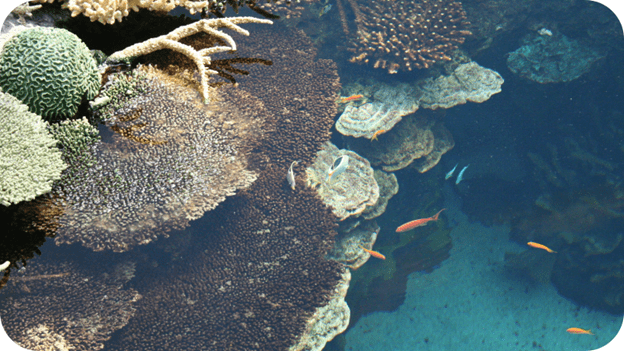
What Is a Coral Garden?
A coral garden is a carefully designed underwater nursery. Think of it as a temporary home for coral fragments, a place where young or broken corals are given a second chance to grow, stabilize and thrive before being replanted onto degraded reef areas.
There are various methods that different coral restoration programs use to create these gardens. From floating trees in nurseries that sway gently in the currents to glass bottle reefs that repurpose recycled materials as coral bases. Each approach is tailored to the environment and resources available.
At REEFolution Trust for example, we use both floating and fixed nurseries in areas like the Wasini Channel, Pillipipa, Kikuyu and the Mkwiro Community Managed Area (CMA). Our coral gardeners or rather reef rangers, many of whom come from the nearby Mkwiro Community, dive in to attach fragments, clean algae, monitor growth and eventually outplant the corals onto artificial reefs that stay in the ocean.
It’s hands-on and time-intensive work. But it’s work that pays off, for the ocean and the people who depend on it.

Why Kenya’s Reefs Needed Help?
Kenya’s coral reefs have taken a hit over the years. Rising sea temperatures triggered by climate change have led to repeated bleaching events, where corals lose their colour and energy source. Add to that destructive fishing practices, sedimentation from land and unregulated tourism and the result is reefs that are struggling to recover on their own.
This isn’t just bad news for marine life, it’s bad news for the coastal communities who rely on healthy reefs for fishing, tourism and shoreline protection.
That’s where restoration steps in.
Coral gardening isn’t about restoring things to the past. It’s about securing the future. Giving reefs the support they need to bounce back faster than they could alone, and bringing communities along.
Who’s Doing the Gardening?
You might expect a coral garden to be the domain of scientists or marine biologists in lab coats. In Kenya, the hands planting corals belong to people like Mwanamisi, a fisher’s daughter from Mkwiro village on Wasin Island, who now works as a Reef Ranger. Or Sadam, who grew up watching reefs decline and now helps monitor nursery sites using waterproof slates, transect tapes and GoPros.
Many of our reef rangers at REEFolution are young, local and learning as they go. Some had never swum in the ocean before joining the program. Others are mothers, former fishermen or curious students from nearby villages.
Training and including local people is at the heart of why this works. It creates ownership, builds capacity and ensures that the knowledge doesn’t vanish when a project ends.
It’s not just reef restoration, it’s community restoration too.
How Do We Know It’s Working?
Restoration is a long game, but the signs of success are already clear.
Some nursery-grown corals are now thriving on the artificial reefs where they have been outplanted. Fish species are returning. Areas that were once barren are showing signs of life. Our monitoring teams have recorded higher coral cover in restored sites compared to nearby degraded areas.
It’s not just the reefs that are bouncing back. Community members involved in the gardening process report improved livelihoods, stronger environmental awareness and a sense of pride in seeing the ocean begin to heal.
In a world that often only measures profit or scale, these kinds of wins matter just as much.
Why It Matters Now More Than Ever
We are living in a time when coral reefs globally are in crisis. The most recent bleaching event occurred from February to May 2024. The event was fueled by record-high sea temperatures, and has affected reefs across the tropics, including right here in Kenya. For a few months after the heatwave, it was still possible to see coral mortality.
We then started filling trees from July until August 2024, with identified corals that did not bleach during the heatwave. More recently, this year we started outplanting corals on a more regular basis.
Coral gardening is part of the long-term solution. It helps create pockets of resilience. It keeps communities engaged and hopeful. It lays a foundation for future regrowth, even during the hard seasons.
We may not be able to stop all the damage, but we can choose to be part of the recovery.
What You Can Do
Not everyone can dive down and tie a coral fragment to a floating tree. However, everyone can play a part in protecting coral reefs.
- Learn: Read about the threats coral reefs face. Knowledge fuels action.
- Share: Talk about coral gardening with others. Most people don’t even know this kind of work exists.
- Support: If you are able, donate to or collaborate with reef restoration organisations like REEFolution Trust Kenya.
- Visit responsibly: If you are near the coast, choose eco-conscious tour operators and avoid damaging reefs while swimming or boating.
- Advocate: Ask your leaders and networks to prioritize climate action, marine protection and sustainable practices.
Coral gardens may start small, with a tie wrap, a floating pipe tree, a broken fragment; but their impact grows with time, care and community.
Coral gardens or nurseries are not just restoring ecosystems. They are restoring connection, hope and a belief that maybe, just maybe, it’s not too late for the ocean to bloom again.
So the next time you hear the word garden, don’t just think of soil and seeds. Think of saltwater and sunlight. Think of coral polyps, patient hands and a coastline fighting to bloom again. Think of Kenya’s coast and the quiet revolution happening just beneath the waves in Shimoni.
You might also like…



How we take action
The reefolution
blueprint

reef rangers
REEFolution offers a 3-month REEF Ranger program which is aimed to provide practical diving and coral restoration skills to local community members.
Read morereef rangers
coral restoration
Our REEF Rangers actively restore coral reefs using a variety of different science-based methods.
Read morecoral restoration
education
Our REEF Rangers visit local primary and secondary schools to provide marine animal ecology classes aimed to increase local awareness.
Read moreeducation
science
Our REEF Rangers collaborate with international scientists aimed to investigate new coral restoration methods
Read more